
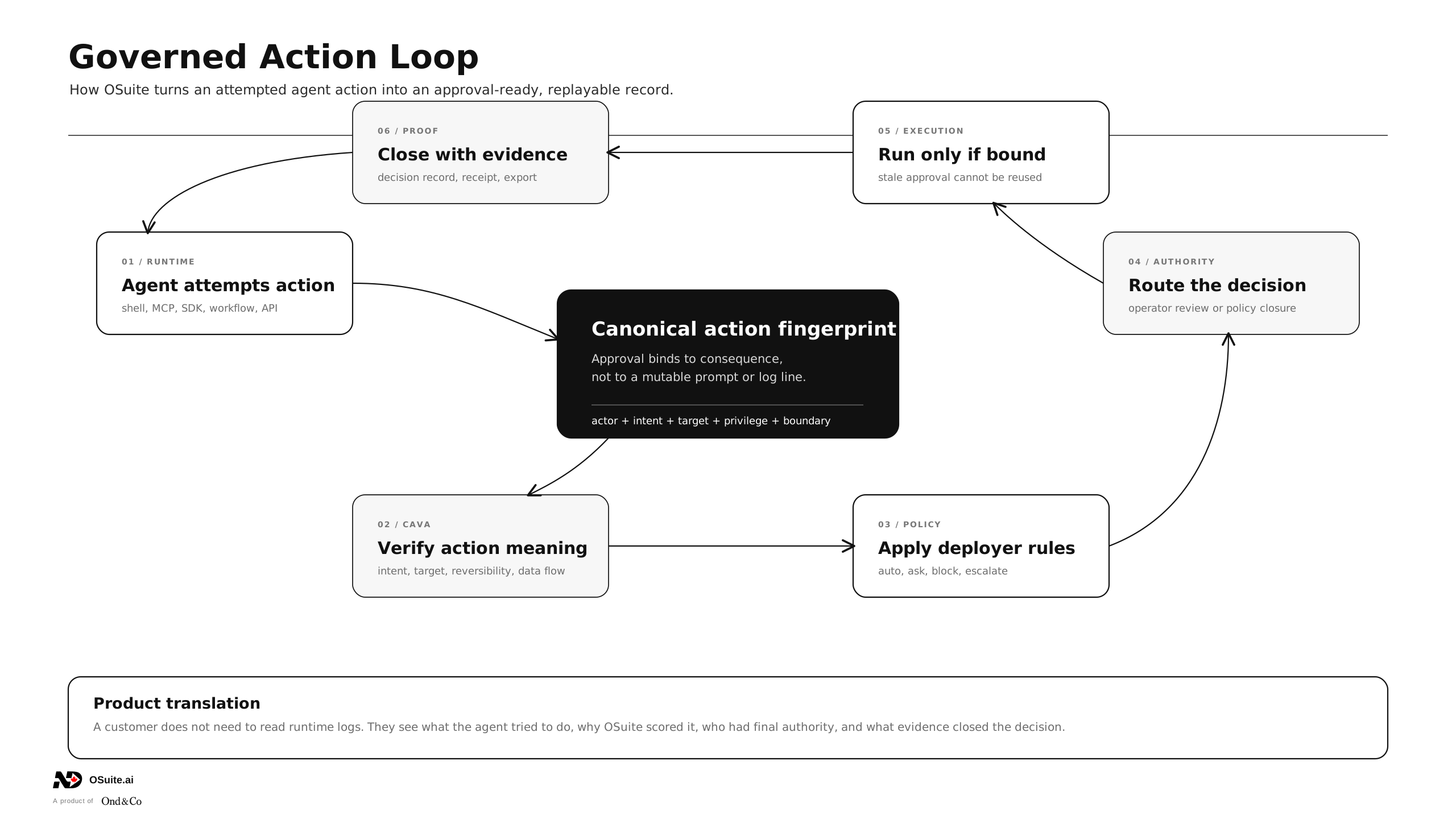
Payments and platform teams are often the first place agent governance becomes real. A coding agent can write tests, patch code, open pull requests, update configuration, and attempt release actions from the same shell surface.
Before OSuite, oversight usually meant reading logs after the fact. High-risk deploys and outbound publishes were governed by convention, not structure, and nobody could prove which exact action a human had approved.
One policy across every lane
The team installs OSuite from the repo root. The connector detects the local agent lane, and deploy-class actions route through a single review queue while routine reads and safe development work stay low-friction.
The useful shift happens quickly. The first time a destructive or release-adjacent command is held before it runs, the team can see the difference between watching and governing.
What the buyer sees
Every approval closes into a replay-ready decision record. The record explains the action, the target, the policy version, the score components, the reviewer, and the closure state.
That is the level of evidence a security team can take into an internal review without hand-waving.
“We let agents move faster precisely because nothing consequential reaches production without a bound approval and a receipt.”