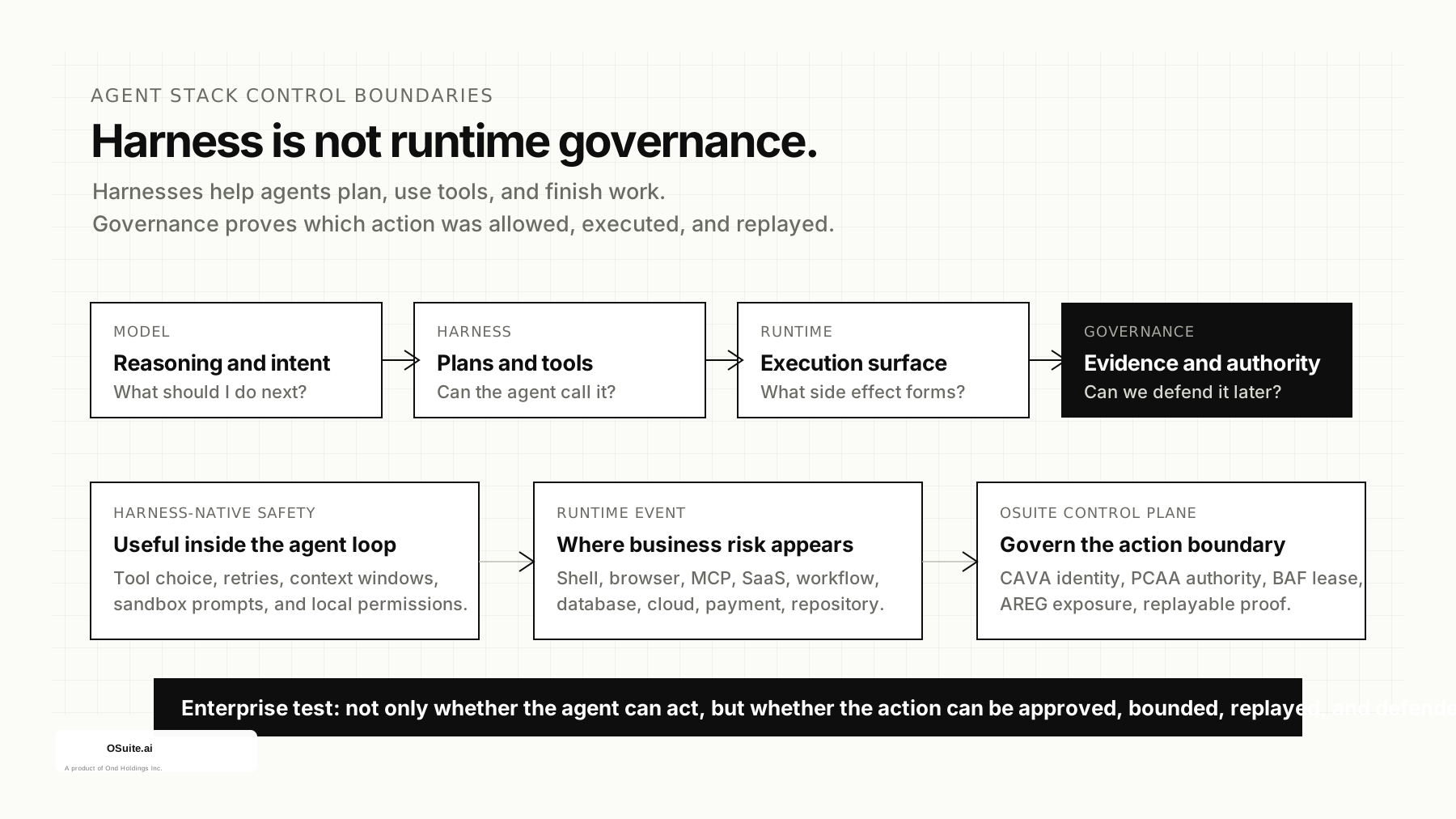
AI agent harnesses help models plan, call tools, and run longer workflows. Enterprise runtime governance answers a different question: what action was approved, what actually executed, and can the proof survive audit?
Harnesses help agents finish work; runtime governance makes agent actions defensible.
The runtime is where the action touches shell, browser, SaaS, APIs, workflows, databases, and cloud systems.
OSuite treats harnesses as sources of proposed actions, not as final governance authority.
The agent market is starting to split into two layers that are often described with the same vocabulary but solve different problems.
The first layer is the agent harness. It is the scaffolding around a model: planning, tool calling, memory, retries, context management, sandbox prompts, permission prompts, and execution loops. A better harness makes an agent more capable. It helps the model keep track of work, call the right tool, recover from failure, and turn an instruction into a sequence of steps.
The second layer is runtime governance. It asks a harder enterprise question: when the agent is about to touch a real system, what exactly is the action, who has authority over it, what boundary was approved, did the execution stay inside that boundary, and can the evidence be replayed later by someone who does not simply trust the original transcript?
These layers are complementary. They are not interchangeable.
Harness, runtime, and governance layers
Why this distinction matters now
As model providers and agent vendors improve their harnesses, agents will become more autonomous in ordinary work. Coding agents will open pull requests. Support agents will prepare refunds. Revenue agents will update CRM records. Finance agents will draft payment instructions. Security agents will query logs and trigger containment actions.
That is progress. It also changes the risk surface.
DeepSeek Harness is a useful recent example of this shift. Its public developer preview is explicitly plugin-first: the harness gives agent builders a composable way to assemble model adapters, tools, sessions, sandboxes, storage, loops, and UI. More importantly for governance, its tool pipeline exposes the right kind of seam: a proposed tool call can be intercepted before execution, the dispatch can be wrapped, and the final result can be observed after execution.
That is exactly the kind of runtime OSuite should target. Not because OSuite wants to become another harness, but because a serious harness gives governance a clean place to attach.
The security review no longer stops at "can the agent call the tool?" Once an agent can create a durable business side effect, the buyer has to ask a different set of questions:
—What was the proposed action in business terms?
—Which identity, workspace, system, and data boundary did it touch?
—Was approval bound to this exact action, or could it be reused?
—Did execution drift from what was approved?
—If an incident happens later, can the organization replay the proof?
Harnesses can reduce mistakes inside the agent loop. They can make execution smoother and more reliable. But they do not automatically create an enterprise evidence object that survives across vendors, runtimes, workflows, and audits.
Four layers, four jobs
One useful way to separate the problem is to ask what each layer is responsible for.
Layer
Main job
Buyer question
Model
Reason over the task and produce intent.
Is the agent capable of understanding the work?
Harness
Turn intent into steps, tools, context, and execution flow.
Can the agent complete the task reliably?
Runtime
Produce the actual side effect in shell, browser, SaaS, workflow, database, cloud, or API systems.
What did the agent actually touch?
Governance
Bind authority, policy, approval, execution, evidence, and replay.
Can the organization defend the action later?
The confusion usually starts because a harness can include some local safety controls. It may ask before running a command. It may classify a tool call as risky. It may keep an execution trace. It may expose an "auto mode" or "approval mode" that changes how freely the agent operates.
Those controls matter. They are useful.
They still do not answer the full governance problem. A local permission prompt is not the same thing as a deployer-owned approval lease. A tool trace is not the same thing as a canonical action object. A vendor session log is not the same thing as replayable proof across heterogeneous runtimes.
A concrete example: opening a pull request
Imagine a coding agent is asked to fix a production bug.
The model reasons about the code. The harness manages the plan, reads files, calls shell commands, runs tests, and prepares a patch. The runtime executes the commands, writes files, creates commits, and opens a pull request.
From a harness perspective, the important question is whether the agent completed the work. Did it understand the issue? Did it use the right tools? Did tests pass? Did it avoid obviously destructive commands?
From a governance perspective, the important question is different. What action was approved? Was the agent allowed only to edit tests, or also production code? Was it allowed to create a pull request, or only prepare a patch? Which repository, branch, files, secrets, and CI permissions were in scope? Did the final pull request body match the approved content? If a reviewer later asks why this action was allowed, can the organization reconstruct the decision without replaying a long, ambiguous chat transcript?
That is where runtime governance begins.
In OSuite terms, the runtime event is converted into a canonical action object through CAVA. Policy and decision routing determine whether the action should be allowed, observed, approved, dual-approved, or blocked. PCAA makes the deployer's authority explicit. BAF turns approval into a bounded lease rather than a reusable permission. AREG maps the runtime exposure and blast radius. The proof bundle preserves the chain so the organization can replay what happened later.
The harness made the agent useful. Governance made the action accountable.
A second example: a high-value refund
Now imagine a support agent receives a high-value refund case.
The harness can help the agent summarize the ticket, retrieve order history, draft a response, and call a refund API. It can also ask the user before taking a sensitive step.
That is still not enough for many enterprises.
The business needs to know whether the approved action was "draft an internal recommendation" or "issue the refund." It needs to know whether customer data crossed into Slack, email, a vendor system, or a public document. It needs to know whether the approval was tied to one customer, one case, one amount, one time window, and one destination. It needs to know whether the final executed action stayed inside the approved boundary.
This is the difference between a helpful assistant and a governed operator.
Where harness-native safety helps
The strongest harnesses will keep improving. That is good for the market and good for OSuite.
Harness-native safety is useful for:
—Reducing accidental tool misuse during a session.
—Asking for local confirmation before sensitive operations.
—Managing sandbox boundaries and command permissions.
—Preserving short-term context around an agent's plan.
—Helping the model recover from failed tool calls.
—Giving the operator a readable trace of the session.
These capabilities are not cosmetic. A serious runtime governance layer should consume them as signals. If a harness labels an action as automatic, manual, approval-required, sandboxed, or externally delegated, that signal should be captured. OSuite can use those signals as part of the evidence path.
The important point is that harness-native safety is a source of governance evidence, not the final governance authority.
For this reason, OSuite now tracks DeepSeek Harness as a target runtime lane in our runtime coverage roadmap and public action-boundary benchmark. The expected adapter shape is straightforward: before tool execution, the Harness plugin sends the proposed action to OSuite for review; after execution, it records the outcome; during export, it attaches the CAVA action artifact and proof bundle so the action can be replayed outside the original harness session.
Where harness-native safety stops
Harnesses are usually scoped to their own execution environment. That creates several limits.
First, harness traces are often vendor-native. They are excellent for debugging the agent that produced them, but weaker as portable governance evidence when the same organization uses multiple agent providers, workflow tools, MCP servers, SaaS agents, and internal automation systems.
Second, harness permissions often describe local capability rather than business authority. "The agent asked before calling a tool" does not prove that the action was approved by the right business owner, under the right policy, for the right resource, within the right boundary.
Third, harness logs can become self-attestation. If the same system proposes the action, executes the action, and asks the buyer to trust its own record, the evidence is useful but incomplete. Enterprises increasingly need proof that can be recomputed, challenged, or verified outside the original agent session.
Fourth, harness-level approval can become stale. An agent may be approved to do one thing, then execute a slightly different action after a rewrite, retry, context shift, tool substitution, or data drift. The governance question is not simply whether approval existed. It is whether approval still covers the executed action.
Why OSuite sits above the harness
OSuite is designed as a governed action layer, not as another agent harness.
That distinction matters. OSuite does not need to replace Claude Code, Codex, LangGraph, workflow agents, MCP gateways, browser agents, or internal automation systems. Those systems can remain where they are strongest: planning and execution.
OSuite sits at the action boundary.
It receives proposed actions from heterogeneous runtimes, normalizes them into governable objects, routes them through policy, binds approval to a bounded lease, records execution outcomes, reconstructs exposure, and exports proof.
The product path looks like this:
OSuite component
What it adds beyond a harness
Runtime adapters
Bring shell, browser, MCP, SDK, workflow, ChatGPT App, and SaaS agent activity into one evidence lane.
CAVA
Converts runtime-specific events into canonical action objects with stable fingerprints.
Policy profiles
Express deployer-owned governance posture across agents and workspaces.
PCAA
Makes final authority explicit and attaches proof-carrying approval to the action.
BAF
Prevents approval from becoming a broad reusable permission by issuing bounded action leases.
AREG
Builds a runtime security map of agents, systems, blast radius, evidence, and unresolved exposure.
Proof bundle
Lets the action be replayed and checked later, including external verifier references when present.
This is why OSuite benefits from better harnesses rather than being displaced by them. The more capable the harness becomes, the more important the governance boundary becomes.
A practical test for enterprise buyers
The easiest way to evaluate a vendor is not to ask whether it has a dashboard, a policy page, or "human in the loop."
Ask for one action and follow it end to end.
The vendor should be able to show:
—The proposed action in canonical form.
—The actor, identity, runtime, tool, resource, data boundary, destination, and expected side effect.
—The policy checked and the decision route.
—The approval owner and whether approval was bound to this exact action.
—The lease scope, expiry, and reuse conditions.
—The executed action and whether it diverged from the approved action.
—The final outcome and side effects.
—The replay or proof bundle that lets a third party inspect the chain.
If the answer is only a transcript or an access log, the system may be useful for observability, but it is not yet full runtime governance.
The risk of treating harness as governance
Treating harness safety as governance creates a subtle failure mode.
The organization may feel protected because the agent asked for permission, the tool call was logged, and the session trace exists. But after an incident, the uncomfortable questions are much more specific. Who owned the boundary? What was approved? What was the exact action? Did the action mutate before execution? Was the approval reusable? What proof survives outside the harness that ran the task?
If those answers are not available, the enterprise has operational memory but not governance evidence.
That difference matters most when the organization is under pressure: after a data leak, a payment error, an unauthorized workflow update, a repository change, a customer-facing message, or a cloud operation that affected production.
What the future stack looks like
The right architecture is not harness versus governance. It is harness plus governance.
Harnesses should keep getting better at planning, tool use, context, retries, and developer experience. Runtime governance should make the resulting actions legible, bounded, approval-aware, and replayable across systems.
The enterprise agent stack will likely settle into a simple split:
Question
Natural owner
Can the agent understand the task?
Model
Can the agent complete the task?
Harness
Can the action execute in a real system?
Runtime
Can the organization defend the action later?
Governance
OSuite is built for the last question.
That question becomes more important, not less, as agents become more capable.