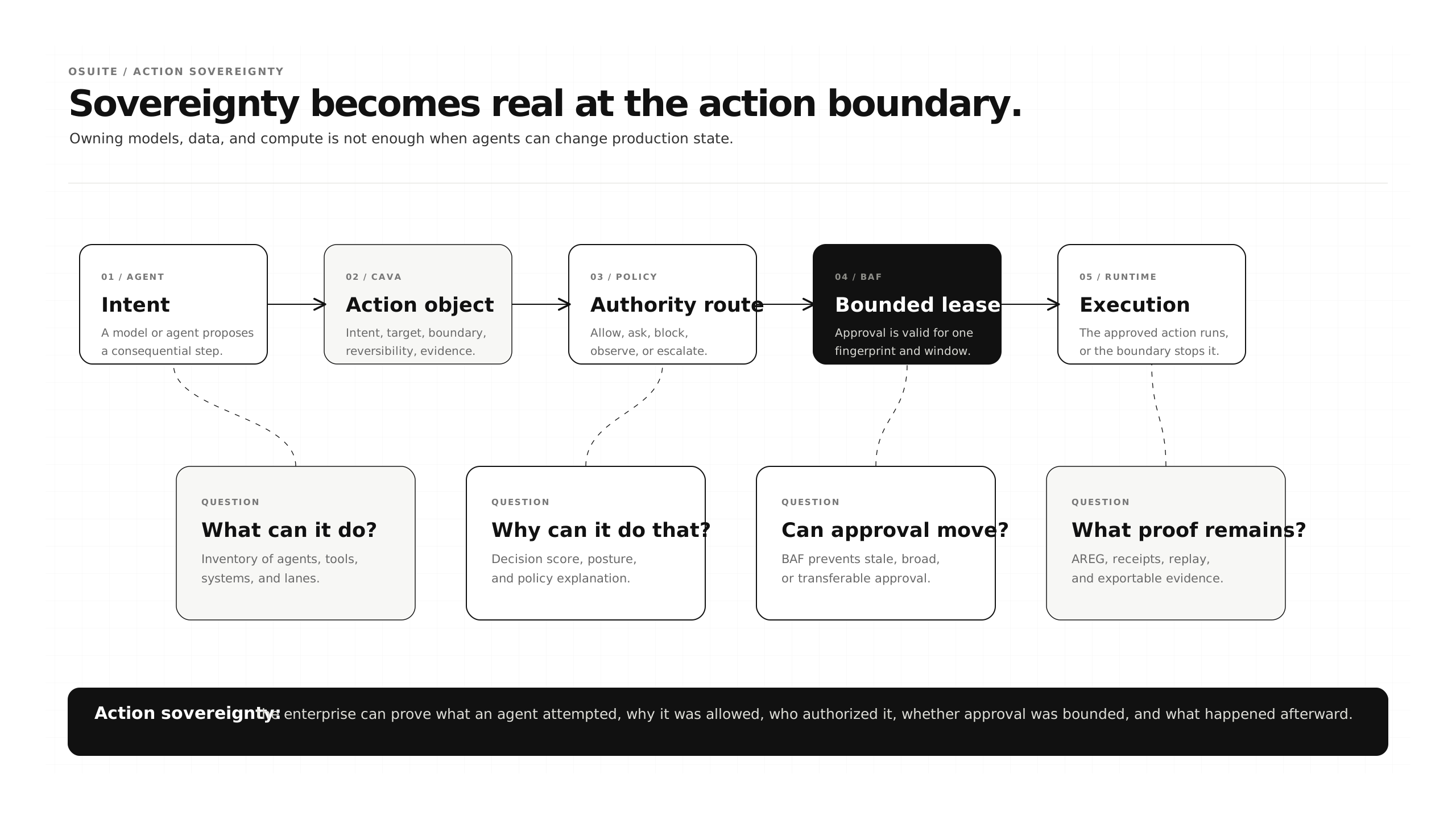
A database log records events after they are emitted; PCAA governs the action before execution.
The difference is not storage. The difference is authority, canonical binding, approval timing, and replayable proof.
OSuite treats logs as evidence inputs, not as the governance layer itself.
One of the most reasonable buyer objections to OSuite is also one of the most dangerous.
"Why do we need this? Can we not just record every agent action in a database?"
Yes, you should record agent actions. Put them in Postgres, Snowflake, Datadog, Splunk, a lakehouse, or whatever your operations team already trusts. Logs are useful. They are necessary for incident review, debugging, analytics, cost control, and compliance evidence.
They are not governance.
Governance is not the existence of a record. Governance is the ability to decide whether an action may happen before consequence forms, bind that decision to the action that actually runs, preserve the authority path, and reconstruct the proof later.
Action sovereignty
The database sees a fact too late
A normal log starts after something emits an event. The agent planned an action, called a tool, updated a record, deployed a change, sent a message, retrieved a file, or failed somewhere in the middle. The log receives a row.
That row may be beautifully structured. It may have a timestamp, user ID, request ID, tool name, session ID, payload hash, and outcome. Still, the row is usually downstream of the thing that mattered.
For routine observability, that is fine. For agent governance, it leaves the buyer with a gap:
—Was the action allowed before it executed?
—Did approval bind to the exact action or only to a summary?
—Could the agent retry with a slightly different target and inherit the same approval?
—Who had final authority over the action?
—What policy version was active at the moment of the decision?
—Was the action blocked, approved, denied, expired, or closed with evidence?
A database can store answers to those questions. It does not produce them by itself.
PCAA is not a better log format
PCAA, short for Proof-Carrying Agent Actions, is not a prettier event schema. It is a governance primitive.
The point of PCAA is to make the action carry the proof required to govern it. Before the action runs, OSuite turns the runtime request into a canonical action object. The action object is what policy evaluates, what approval binds to, and what the proof bundle later reconstructs.
A database record can say, "the agent requested a deployment." PCAA asks a stricter question: what deployment, by which actor, against which target, under which privileges, with what reversibility, using which policy route, approved by whom, and bound to which action fingerprint?
That difference matters because agents do not always act through one clean interface. A coding agent may use shell commands. A workflow agent may call an API. A ChatGPT App may review planned work before browsing or summarizing a page. A Dify workflow may route through plugin metadata. An n8n node may call the same governance endpoint from a different operational context.
Without a canonical action layer, your logs become a museum of incompatible runtime events.
The buyer mistake is confusing evidence with control
Security teams already understand this in other domains.
A SIEM is not access control. A packet capture is not a firewall. An EDR alert is not least privilege. A database audit table is not a transaction approval system.
Agent governance follows the same pattern. Logging is evidence. Control is the boundary that decides whether the action should proceed.
If an AI agent proposes to update a production workflow, export customer data, publish a message, modify a policy, or deploy code, the organization needs more than a later record. It needs a pre-action control point.
OSuite treats the database as part of the evidence surface, not as the authority surface.
What a database cannot decide alone
Consider a simple action: an agent wants to run a command that looks like a normal deployment.
A database can store the command. It can store the timestamp. It can store the user account. If the logging path is good, it can even store the result.
What it cannot know by default is whether `payment-api` is production-adjacent, whether `main` triggers deployment, whether the change touches regulated logic, whether the actor is a human, an agent, or a wrapper, whether the approval lease should expire after one use, or whether this action is allowed under the customer's current policy posture.
Those are governance questions.
PCAA makes those questions first-class. CAVA analyzes the action's consequence. Policy profiles route it. BAF bounds the approval. AREG maps the exposure. The log then becomes useful because it records the output of a governance process instead of pretending to be the process.
The proof needs to survive disagreement
Another reason a plain database log is too weak: it often records the final state and loses the argument.
Enterprise governance is not always a clean yes or no. Someone may dissent. Someone may approve an exception. A policy may allow the action only under a narrow boundary. A verifier may confirm the evidence hash while partner-side identity mapping remains incomplete. A human may approve the action, but only for one session and one target.
Those details are not decorative. They are exactly what a buyer, auditor, or incident reviewer will ask for later.
PCAA is designed so the proof bundle can carry the shape of the decision, not merely the final label.
Where the log belongs
None of this means databases are useless. The opposite is true. A serious OSuite deployment should export governed action evidence into the customer's existing data stack.
The clean architecture is:
Layer
Job
Runtime adapter
Captures the attempted agent action from hooks, MCP, SDK, workflow, app, or gateway.
CAVA
Converts the runtime event into a canonical action object.
Policy and Decision Score
Routes the action as allow, observe, approval, dual approval, or block.
PCAA
Binds authority and proof to the action.
BAF
Converts approval into a bounded action lease.
Log store
Retains the evidence, outcome, export, and analytics trail.
The database is the archive. OSuite is the control path.
The practical answer
If a buyer asks whether they can just log every action in a database, the honest answer is:
You should log every governed action. You should not mistake the log for governance.
The meaningful product question is not "where is the row stored?" It is "what control decision produced the row?"
OSuite exists because agent actions need to be governed before they become facts in someone else's database.