Auto mode is not the problem.
It is probably where agent products have to go.
If a coding agent has to ask for permission on every small action, the experience stays trapped between a chatbot and a junior automation script. The useful version is more autonomous: it can inspect a repo, run tests, edit files, retry commands, and keep working without turning every step into a meeting.
That is a real product improvement. It is also why enterprise governance has to move down into the runtime action layer.
When an agent becomes more autonomous, the governance object can no longer be only the prompt, the model response, or the tool list. Those are still signals, but they are not the thing that creates consequence. The control point is the proposed action at the moment it is about to touch a file, API, database, ticket, repository, cloud resource, customer record, or production system.
Runtime permission mode is evidence, not authority
Modern agent runtimes increasingly expose their own permission posture. A runtime may be in manual mode, auto mode, plan mode, accept-edits mode, or some form of bypass mode. It may auto-allow a tool call, block it locally, or fall back to asking the user.
That signal matters.
It tells the enterprise whether the action was passing through a runtime classifier, a human prompt, a bounded edit mode, or a permission bypass. But it should not be treated as final authority by itself.
OSuite now records this as a runtime autonomy signal inside the governed action:
| Signal | What it captures |
|---|
| `runtime_permission_mode` | Whether the runtime was operating in auto, manual, accept-edits, bypass, plan, or unknown mode. |
| `runtime_permission_decision` | Whether the runtime auto-allowed, auto-blocked, prompted, bypassed, or otherwise handled the tool call. |
| `runtime_autonomy_level` | A normalized posture such as runtime classifier, human prompted, bounded edit autonomy, or permission bypass. |
| `osuite_binding` | The OSuite evidence binding, currently the CAVA action fingerprint. |
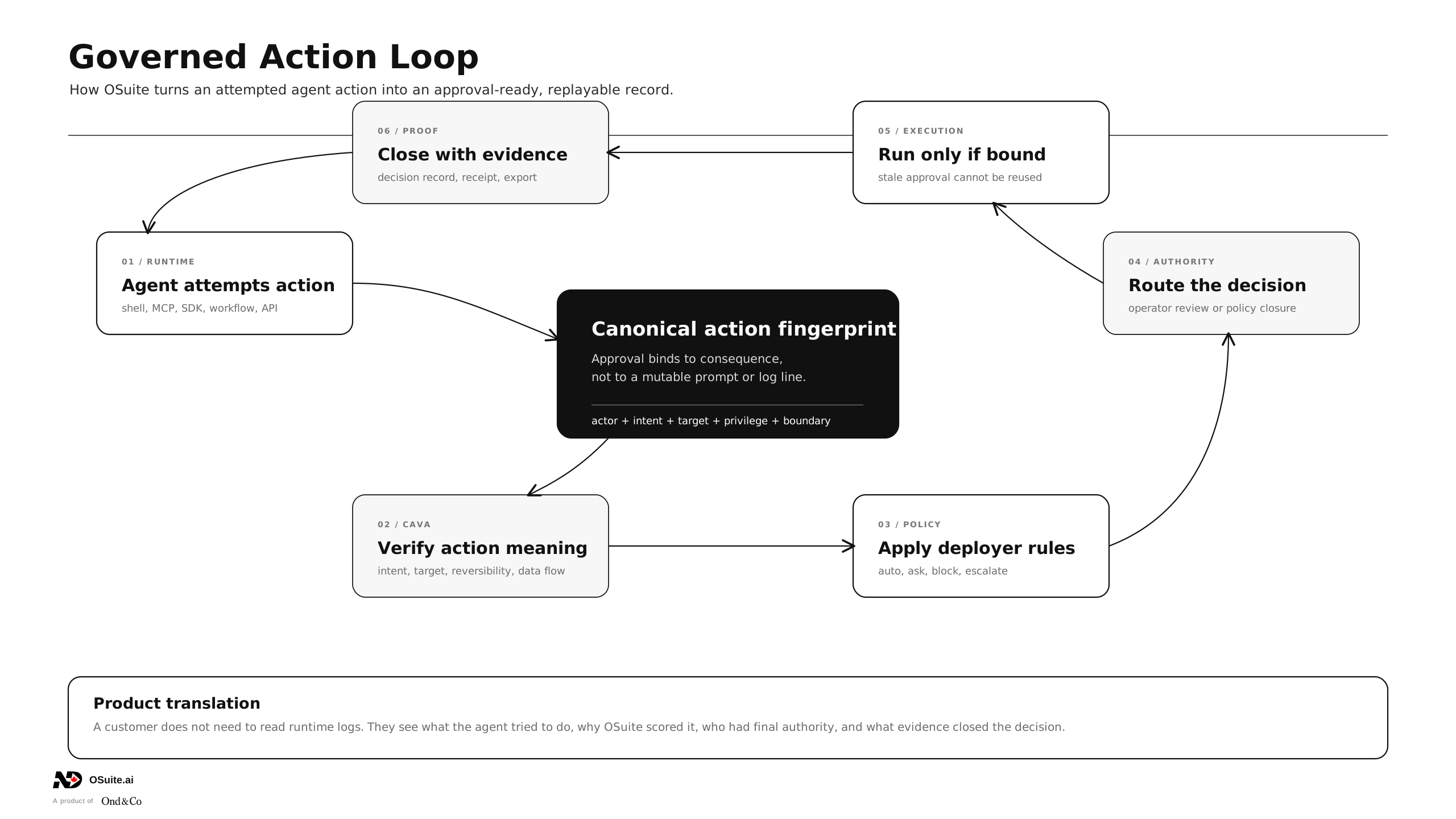
The important design choice is that OSuite does not blindly inherit this signal as the governance decision. The runtime's local decision becomes part of the evidence. OSuite still canonicalizes the action through CAVA, applies workspace policy, binds approval to the action, and records the outcome through replay.
That distinction is the difference between "the agent runtime said this was okay" and "the enterprise can reconstruct why this exact action was allowed to happen."
Why this matters for buyers
Auto mode makes the user experience better by reducing friction.
It can also make the evidence problem harder.
If an agent performs twenty small steps before a human looks again, a normal transcript is not enough. The buyer will eventually ask a more concrete set of questions:
- —Which actions did the runtime auto-allow?
- —Which ones were escalated to OSuite policy?
- —Which action was actually approved?
- —Did execution still match the approved action?
- —Which files, systems, credentials, or external destinations were touched?
- —If something went wrong, can the proof be replayed without trusting a summary written after the fact?
Those questions are not answered by saying an agent was "safe" or "human supervised." They require a governed action object.
Where CAVA fits
CAVA exists because runtime events are messy.
The same business action may appear as a shell command, an MCP tool call, a browser step, a workflow node, an SDK request, or a managed-agent event. A runtime permission signal tells OSuite how the local runtime treated the step. CAVA tells OSuite what the step actually means as an action.
For example, a runtime may report that a tool call was auto-allowed. That is useful, but OSuite still needs to know whether the action was:
- —reading local files;
- —pushing code;
- —exporting customer data;
- —creating a public link;
- —changing cloud infrastructure;
- —invoking a payment or wallet action;
- —weakening a security control;
- —crossing a tenant or destination boundary.
CAVA turns that runtime-specific event into a canonical action object with a fingerprint. Policy can then reason over consequence instead of over a raw command string.
What changes in Studio
In OSuite Studio, the runtime governance contract now has a visible runtime autonomy section.
For a governed action, Studio can show:
- —the runtime family and adapter mode;
- —the runtime permission mode;
- —the runtime's native decision posture;
- —the OSuite binding used to govern the action;
- —the PCAA checkpoint state;
- —the action envelope, replay evidence, and final outcome.
The customer-facing point is simple: OSuite does not ask teams to trust that auto mode was safe. It records how auto mode behaved, then binds that behavior to a governed action object and policy decision.
The product direction
More autonomy is not optional. Agent products will keep moving toward fewer prompts, longer tasks, and more background execution.
The governance layer has to adapt without turning every action into human friction.
That means separating three things that are often blurred together:
| Layer | Question |
|---|
| Runtime permission | Did the local agent runtime allow, block, prompt, or bypass this step? |
| Action governance | What action was actually being attempted, and did it fit the enterprise boundary? |
| Proof and replay | Can someone later reconstruct the decision, approval, execution, and outcome? |
OSuite's view is that enterprise buyers will need all three. Runtime vendors can keep improving autonomy. OSuite can sit across runtimes and preserve the action boundary, authority path, and evidence trail.
That is the shape of governed autonomy: agents can do more work, but consequential actions still close into a boundary the organization can understand, approve, and replay.