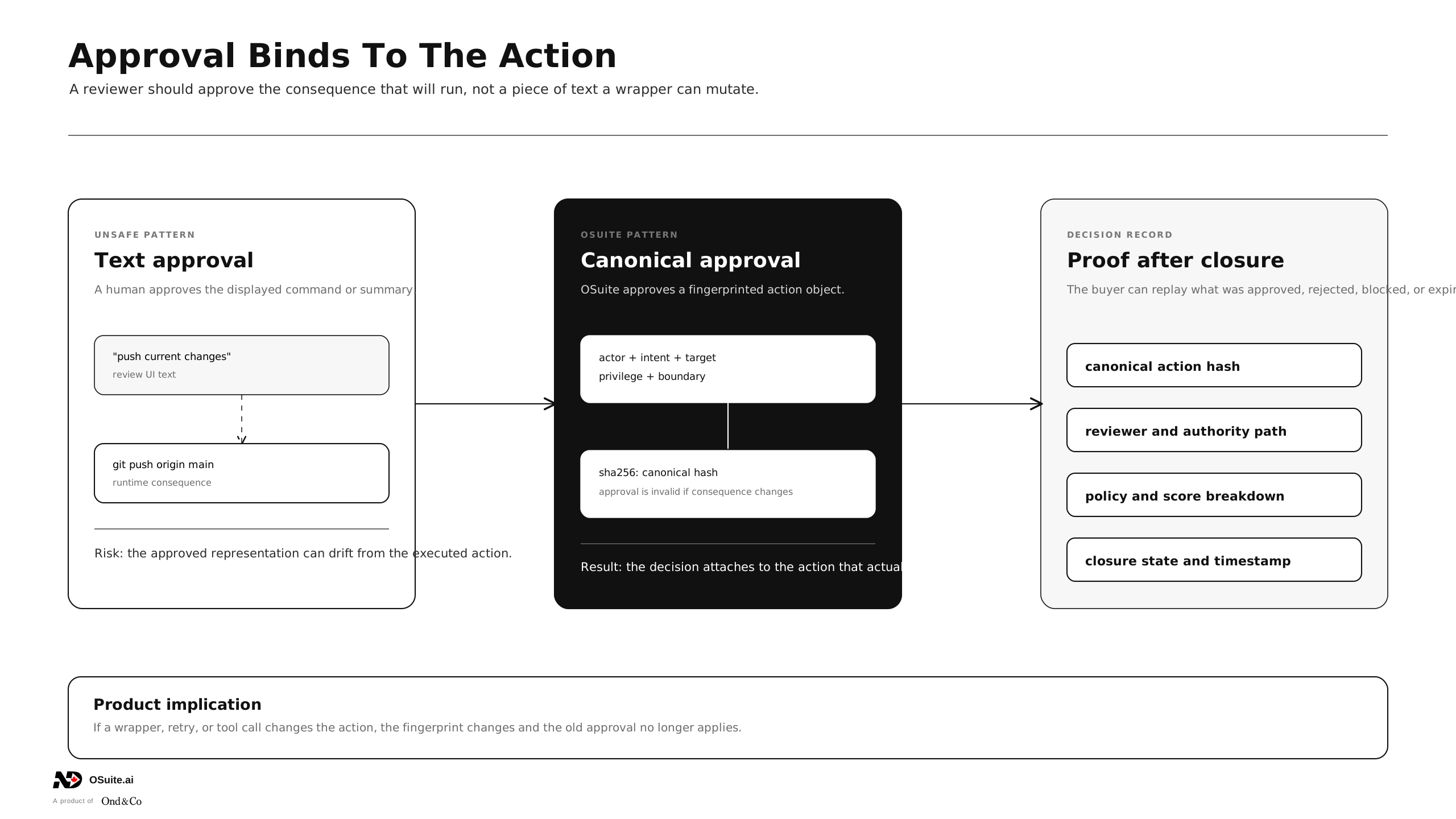
Microsoft Agent 365 is a useful signal for where the market is going. But enterprise agent registries and lifecycle control planes still need an action-boundary proof layer underneath real side effects.
Agent registries help enterprises know which agents exist. They do not automatically prove what action was approved or what executed.
OSuite now treats Agent 365-style registry data as a target runtime lane in Studio and the public Runtime Boundary Benchmark.
The durable control point is the action boundary: identity, policy, approval, execution, outcome, and replayable proof.
The agent market is becoming more honest.
For a while, a lot of companies described themselves with the same words: secure agent runtime, agent platform, agent control plane, MCP gateway, observability, governance. The words were not wrong, exactly. They were just too broad. They made very different layers sound like one product.
Microsoft entering the conversation with Agent 365 is useful because it forces a cleaner split.
An enterprise will need to know which agents exist, who owns them, what lifecycle state they are in, which identity plane they sit under, what tools they can reach, and which policies attach to them. That is a real control-plane problem. Large organizations will not run thousands of production agents through spreadsheets and vibes.
But registry is not proof.
A registry can tell you that an agent was known. It can tell you that an agent had an owner. It can tell you that the agent belonged to a group, workspace, policy set, or lifecycle stage. It can help with inventory, access, posture, and enterprise management.
It does not automatically answer the harder incident question:
What exact action was approved, what actually executed, and can someone replay the evidence later without trusting the original platform narrative?
That is the layer OSuite is built for.
Approval-bound action proof
The stack is splitting
The emerging enterprise agent stack has several layers:
Layer
What it answers
Model
Can the system reason over the task?
Harness
Can the system plan, call tools, retry, and complete work?
Runtime
Can the action execute against files, browsers, APIs, SaaS, cloud, or workflows?
Registry / control plane
Which agents exist, who owns them, and what lifecycle or access posture applies?
Action-boundary proof
What action was approved, did execution drift, and what evidence survives audit?
These layers should work together. The problem starts when one layer claims to solve all the others.
A harness trace is not always governance. A registry entry is not always proof. An access-control log is not always approval binding. A dashboard is not always replay. A tool permission is not always business authority.
That distinction matters because enterprise risk usually appears at the point where an agent action becomes a durable side effect: code changes, payment steps, customer messages, data exports, workflow updates, cloud mutations, or third-party SaaS writes.
Where Agent 365-style systems help
Agent registry and lifecycle systems are valuable. In fact, OSuite should consume those signals rather than pretend they do not matter.
Useful registry signals include:
—agent identity and ownership;
—lifecycle state;
—workspace or tenant binding;
—policy group;
—allowed tool surface;
—identity and access context;
—audit and observability references;
—deprecation, suspension, or exception status.
Those signals make the action boundary stronger. If a production refund agent is not registered, that matters. If the agent is suspended, that matters. If the registry says it is read-only but runtime evidence shows a write action, that matters. If a policy group changed between approval and execution, that matters.
But those signals are still inputs.
The governed object is the action.
What OSuite adds
OSuite now treats Agent 365-style registry records as a target runtime lane in Studio and in the public Runtime Boundary Benchmark.
That means OSuite does not need to replace the registry or lifecycle control plane. It uses registry context as evidence, then closes the loop around the action itself.
Concretely:
OSuite primitive
What it contributes
CAVA
Converts the runtime-specific event into a canonical action object and stable fingerprint.
PCAA
Makes final authority explicit: who is allowed to approve this action under this workspace boundary.
BAF
Prevents approval from becoming a broad reusable permission by binding it to scope, time, policy, and execution context.
AREG
Maps the runtime exposure around the action, including systems touched and blast radius.
Proof bundle
Preserves the decision, approval, execution, outcome, and verifier references for later replay.
This is why OSuite can sit next to Agent 365, AgentCore, Gemini Enterprise Agent Platform, ServiceNow, Salesforce, LangGraph, Claude, ChatGPT Apps, Codex, DeepSeek Harness, n8n, Dify, and custom internal agents. Each platform has its own runtime or management surface. OSuite focuses on the action-boundary evidence that has to survive across them.
A concrete example
Imagine a company has a registered support agent.
The registry says:
—the agent exists;
—it belongs to the support workspace;
—it is active;
—it is owned by the support operations team;
—it has access to support tickets;
—it is under a strict enterprise policy group.
That is useful.
Now the agent attempts an action.
The approved action is:
text
Read the registry entry and support case metadata for internal review.
The executed action is:
text
Update a production customer case and send a customer-facing message.
Those two actions may share the same agent identity. They may happen inside the same enterprise platform. They may appear under the same registry record.
They are still not the same action.
OSuite's job is to catch that boundary change. The action fingerprint changes. The effect changes. The destination changes. The resource changes. The approval no longer covers execution. The result should be blocked, reviewed, or escalated depending on policy.
That is the difference between knowing the agent exists and proving the action was authorized.
What changed in OSuite
We made the product and benchmark reflect this split.
In Studio, Agent 365 now appears as a Microsoft managed workspace/control-plane lane. Fast Connect can detect Agent 365-style registry exports and place them under a strict enterprise profile. Runtime inventory can show it separately from Microsoft Agent Framework and Azure Foundry, because those are different surfaces: framework SDK, managed runtime, and registry/control plane.
In the public Runtime Boundary Benchmark, we added an `agent365-registry` target lane. It covers cases where registry and lifecycle metadata are present, but execution still has to be checked against the approved action boundary.
The latest generated corpus has:
Metric
Value
Total records
6,000
Runtime surfaces
20
Agent 365-style registry records
237
Agent 365-style risky records
194
Safe baseline records
1,000
Risky records
5,000
The point is not that OSuite has a production Agent 365 adapter today. The point is that the action-boundary model already handles the shape of the evidence: registry metadata comes in, CAVA turns the attempted side effect into a stable action object, policy evaluates it, and proof export preserves the result.
The buyer test
When an enterprise evaluates an agent platform, the useful question is not only:
Do you have a control plane?
A sharper set of questions is:
—Can you show the exact action that was approved?
—Can you show the exact action that executed?
—Can you prove the two still match?
—Can approval expire or be scoped to one action?
—Can a third party replay the evidence without trusting the vendor's UI?
—Can this work across more than one agent runtime?
Agent registries and lifecycle systems are necessary. They are not the final evidence object.
The future stack is not one winner eating every layer. It is a layered architecture where each part does its job well.
Agent control planes manage fleets.
OSuite makes the consequential actions defensible.