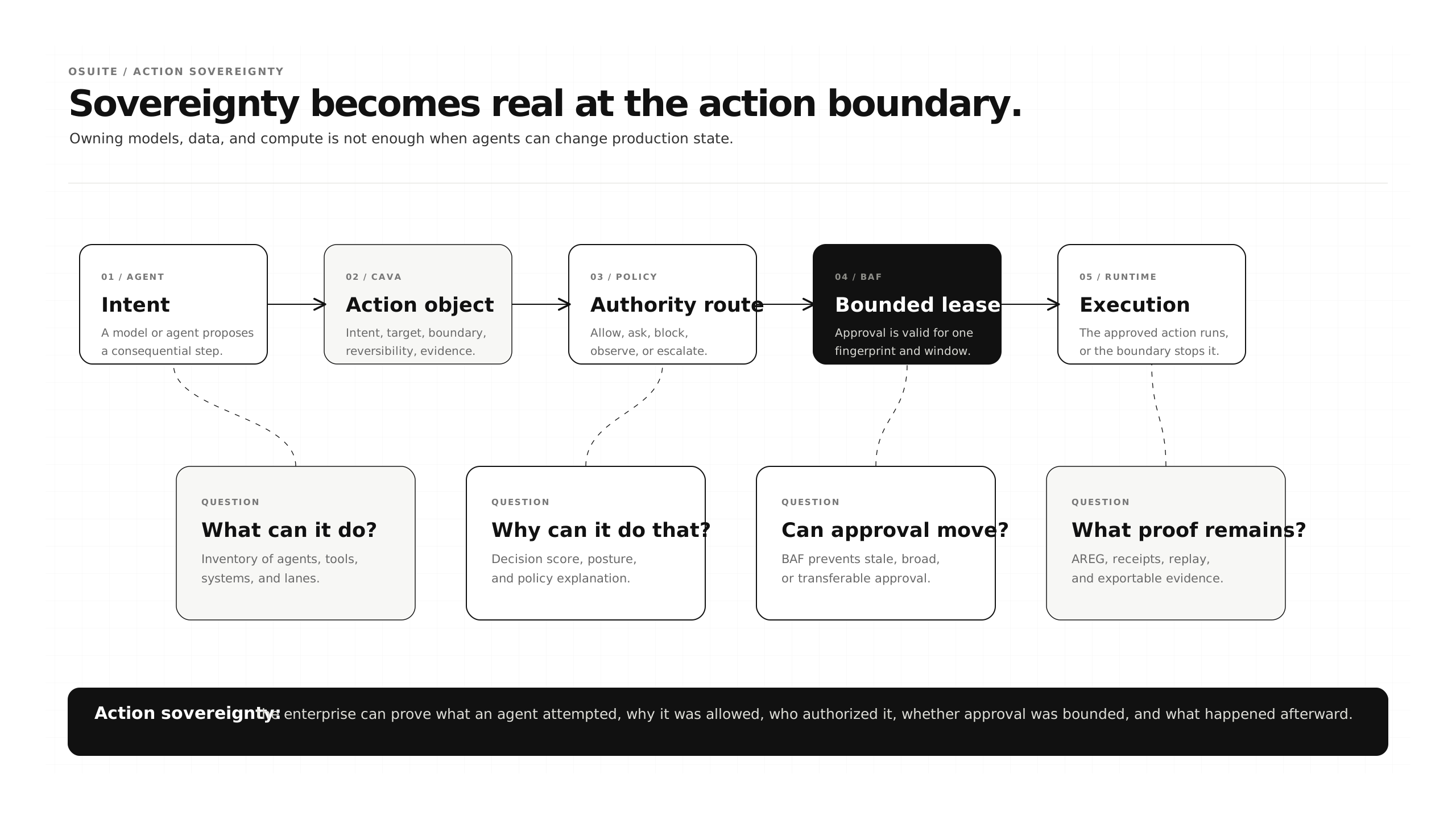
AI sovereignty is not complete until enterprises can govern what agents are allowed to do.
The action is the boundary where model output becomes business consequence.
OSuite maps that boundary through PCAA, CAVA, policy posture, BAF, AREG, and replayable proof.
The market is finally becoming more precise about AI sovereignty.
For a long time, the discussion was mostly about model access. Which frontier lab owns the model? Which cloud hosts it? Which provider can see the prompt? Which vendor controls the roadmap? Those questions still matter. Enterprises should care about their data, their infrastructure, their model choices, and their ability to avoid being trapped inside someone else's strategic agenda.
But that is not the whole problem.
Once AI systems move from answering questions to taking actions, sovereignty has another layer. The enterprise must be able to govern the action itself.
Can the agent send customer data to an external endpoint? Can it issue a refund? Can it push code? Can it delete a table? Can it call a production API? Can it publish a message, update a record, open a payment step, or approve a workflow?
That is where AI sovereignty becomes operational. The action is the point where model output becomes business consequence.
Action sovereignty for AI agents
The action is the sovereignty boundary
Most enterprise AI discussions still treat governance as something around the model. The model is evaluated, the prompt is filtered, the output is reviewed, and a policy says a human should remain in the loop.
That framing is useful, but incomplete.
An agent does not create enterprise risk only by producing text. It creates risk when it touches systems. A coding agent touches repositories and release paths. A support agent touches customer records. A finance workflow touches invoices, vendors, payment preparation, and approvals. A data agent touches warehouses, exports, dashboards, and downstream decisions. A security agent touches tickets, configurations, response workflows, and identity surfaces.
The moment the agent can act, the enterprise needs to know more than whether the output looked reasonable. It needs to know what the agent attempted, which system it touched, what permission was required, which policy applied, whether the action was reversible, whether approval was needed, who had authority, whether approval could be reused, and what evidence survived.
That is action sovereignty.
Infrastructure sovereignty is necessary but incomplete
Owning compute, data, and model choice is important because it protects institutional independence. A company should not casually hand over its proprietary workflow, operational data, or internal decision structure to a vendor that may later move into the same market.
But infrastructure control does not automatically create runtime control.
A company can self-host a model and still let an agent run unsafe operations. It can own its data warehouse and still allow an automation to export sensitive records. It can use an open model and still fail to prove which action was approved. It can run inside its own cloud and still have no reliable way to show whether a human approval applied to the actual action that executed.
The enterprise does not only need sovereignty over where intelligence runs. It needs sovereignty over what intelligence is allowed to do.
This is the part that dashboards usually miss. A dashboard can summarize activity after the fact. A control plane has to shape the action before consequence forms.
What action sovereignty has to prove
Action sovereignty is not a slogan. It has control properties.
At minimum, the enterprise should be able to answer:
—What action did the agent propose?
—Which runtime, session, tool, account, system, and target produced it?
—What was the intended business consequence?
—Which policy posture applied at the time?
—Was the action allowed, blocked, observed, escalated, or held for approval?
—Who had final authority to approve it?
—Was the approval bound to the exact action, or was it broad and reusable?
—Did the executed action still match the approved action?
—What proof remains if an auditor, customer, regulator, or internal reviewer asks later?
If the system cannot answer those questions, the organization is not governing actions. It is trusting that the agent, the operator, the vendor, and the log all stayed aligned.
That may be acceptable for low-risk productivity work. It is not enough for production workflows.
Where OSuite sits
OSuite is built around the action boundary.
PCAA, Proof-Carrying Agent Actions, defines the governance kernel: final operational authority belongs to the deployer, and approval should bind to the action that will actually execute.
CAVA turns messy agent behavior into a canonical action object. Instead of treating a raw command or tool call as the whole truth, CAVA separates intent, target, privilege, boundary, reversibility, data movement, runtime identity, policy pattern, and evidence quality.
Policy posture lets the customer decide how strict the boundary should be for a workspace, an agent, a runtime lane, or a class of action.
Decision Score v2.1 converts those signals into a route the business can understand: allow, ask, block, observe, or escalate, with a breakdown rather than a mysterious number.
BAF, the Bounded Action Firewall, turns approval into an Action Gate Lease. The approval is valid only for the canonical action, policy version, actor, runtime session, destination scope, time window, and proof receipt it was issued for. If the consequence changes, the approval no longer applies.
AREG, the Agent Runtime Exposure Graph, maps agents, runtimes, tools, actions, systems, policies, leases, and evidence into a runtime security map. It answers the incident question every serious buyer eventually asks: if this agent goes wrong, where can the damage travel?
The customer does not need to remember the acronyms first. The product question is simpler: what can the agent do, why can it do that, who approved it, can that approval be reused, and what proof remains?
Why bounded authority matters
Human approval is often treated as a finish line. In reality, approval is another risk surface.
If approval is only a yes/no state, it can drift. A user may approve one action and accidentally authorize a different destination, a later retry, a broader command, a modified payload, a changed policy version, or a second execution outside the original context.
That is why action governance needs bounded authority.
Approval should not be a reusable permission token. It should be a narrow lease attached to a specific action fingerprint and context. It should expire. It should fail closed when the action changes. It should be reconstructable later without relying on someone's memory of what they thought they approved.
This is one of the biggest differences between policy theater and runtime control.
Policy theater says a human was involved. Runtime control proves what the human approved, when they approved it, which action the approval applied to, and whether the executed action stayed inside the approved boundary.
The market is moving toward proof
The direction of travel is clear. Enterprises are becoming less impressed by generic AI claims and more interested in control, evidence, independence, and operational durability.
That shift is healthy.
During a hype cycle, buyers tolerate vague language because the upside feels urgent. During a trust cycle, buyers ask harder questions. They want to know what the system can prove. They want to know whether vendor promises survive incidents. They want to know whether governance exists inside the runtime or only in a policy document.
Agent systems will make this sharper. A model answer can be corrected. A production action may have already changed the business.
The standard should therefore be higher. The enterprise should own its data, model choices, compute posture, operating language, and action boundary. It should be able to use different models and different agents without losing governance. It should be able to replay evidence even after providers, tools, policies, or workflows change.
That is the practical meaning of sovereignty in agentic AI.
The standard
AI sovereignty should not stop at model choice.
For enterprise systems, sovereignty has to include the right to define, approve, constrain, observe, challenge, and replay the actions that AI agents attempt inside the business.
The future of enterprise AI will not be decided only by who has the strongest model. It will also be decided by who can safely turn intelligence into action without surrendering operational authority.