Architecture note · September 20, 2026 · 12 min read
Agents should not ask for permission every time. They should carry bounded action passes.
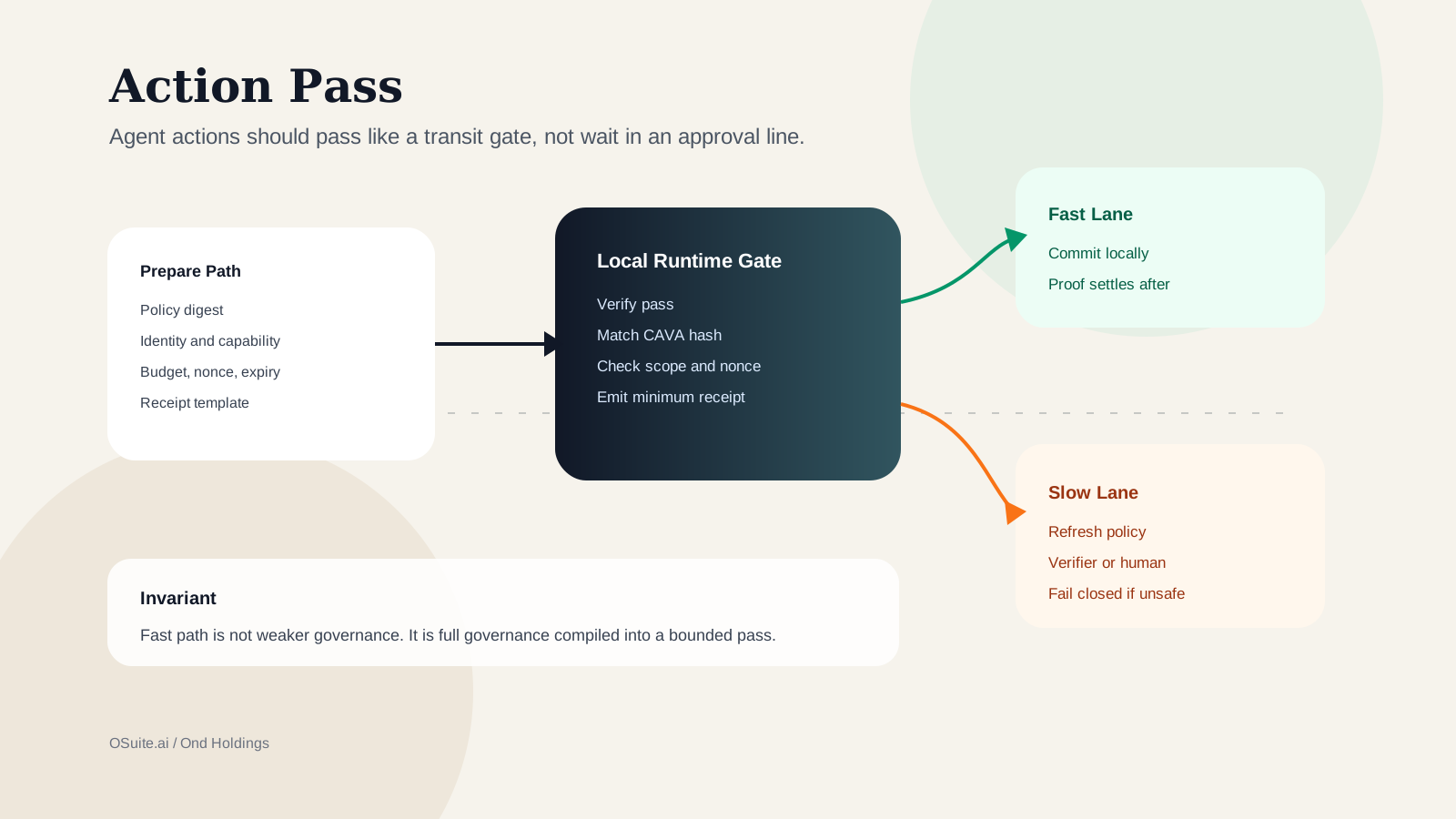
Inspired by Suica-style infrastructure, OSuite is exploring Action Passes: short-lived, consumable tickets that let ordinary agent actions commit locally while risky, stale, or ambiguous actions slow down.
Identity gets an agent to the gate. An Action Pass decides whether the exact action gets through it.
The common path should be local, deterministic, bounded, and receipt-first.
A2A, MCP, and agent harnesses can carry an Action Pass, but they do not define its governance semantics.
The most useful lesson from Suica is not that the card feels fast. It is that the system is designed so the common correct path has almost nothing left to decide at the moment of passage.
The passenger does not negotiate with a remote ticket office at the gate. The card carries enough state. The gate evaluates locally. The normal case is short, deterministic, and quiet. The accounting system can settle later, but the gate has already made a bounded decision.
That is the direction we want for AI agent governance.
Most agent governance products still feel like an approval queue attached to an automation stack. The agent asks, a policy service answers, a human may approve, an audit log receives a record, and a later replay view tries to reconstruct what happened.
That model is useful. It is also too heavy to become the default path for every production agent action.
OSuite Action Pass architecture
The shift
An agent should not ask for permission from scratch every time.
For ordinary work, the agent should carry a bounded action pass.
That pass should say, in a machine-checkable way:
—who issued the pass;
—which agent, principal, workspace, and runtime session may use it;
—which canonical action hash it binds to;
—which policy digest and approval state it depends on;
—which operation, effect, resource, destination, and constraint set are in scope;
—when it expires;
—whether it has already been consumed;
—what minimum receipt must be emitted before the action commits.
The runtime gate should then do the smallest possible amount of work:
No model call. No remote verifier call. No approval database lookup. No full proof export on the critical path.
If the pass is fresh and bound to the action, the action passes.
If the pass is stale, missing, reused, unbound, or outside scope, the gate does not improvise. It routes to the slow path or fails closed.
Identity gets you to the gate
Protocols such as A2A, MCP, OAuth, mTLS, and API keys are important. They help establish who is communicating, which agent is reachable, how tasks move, and how tool access is authenticated.
But identity is not the same as action authority.
In transit terms, identity gets you to the gate. The pass decides whether this trip can go through the gate.
For agent systems, that distinction matters. A2A can carry the pass. MCP can expose the tool call. A harness can orchestrate the workflow. None of those layers automatically answer whether this exact action, with this resource, this destination, this policy version, this approval state, and this execution nonce should be allowed to form a side effect.
That is the OSuite layer.
Fast lane and slow lane
The Action Pass model gives us two explicit paths.
Path
What it is for
Example
Fast lane
Fresh, scoped, low-ambiguity actions that can be checked locally.
Read one support ticket, write one internal note, hand off context to another internal agent.
Slow lane
Stale, ambiguous, high-risk, or verifier-dependent actions.
Policy changed, tool schema drifted, amount evidence is missing, external verifier is required but not prepared.
This is not weaker governance. It is the opposite.
The fast lane is the portion of governance that has already been compiled into a short-lived, signed, non-reusable pass. The slow lane is where the runtime refuses to pretend that stale or ambiguous facts are safe. Fail-closed is where the system protects the business from pass reuse, drift, or missing evidence.
Receipt first, proof later
OSuite has always cared about replayable evidence. CAVA gives the action a stable identity. PCAA keeps final authority explicit. BAF makes approval bounded instead of reusable. AREG maps runtime exposure.
The Action Pass does not replace those primitives. It changes when work happens.
The full proof bundle can be enriched after the action commits. The important condition is that the later proof must remain bound to the minimum receipt emitted at the gate.
That is the line between serious evidence and delayed logging.
What this changes for users
For an operator, the product should stop feeling like a wall of approvals.
The normal view should look more like traffic management:
—which agents have valid passes;
—which actions are passing locally;
—which actions were slowed down and why;
—which passes were consumed;
—which receipts are waiting for proof enrichment;
—which actions failed closed.
For a security team, this changes the review conversation. Instead of asking whether an agent was allowed to use a tool, they can ask whether the action presented a valid pass at the boundary.
For a business owner, it changes rollout economics. Governance no longer has to mean putting a human in every loop. The organization can reserve human attention for the actions where the pass is stale, ambiguous, high-risk, or missing.
What we are publishing first
We are starting with a small public reference artifact in the Agent Action Boundary Benchmark repository.
It defines:
—an `Action Pass` schema;
—fast-lane, slow-lane, and fail-closed cases;
—an A2A-style handoff case where A2A carries the pass but OSuite gates the action;
—a minimum receipt model;
—metrics for fast path coverage, zero-wait ratio, receipt emission, and false fast allow.
The benchmark is deliberately not a production latency claim. It is a crisp first test of the architecture:
Can the runtime choose the right path before an agent action becomes a side effect?
That is the right starting point. Before we claim microseconds, we need to prove the lane semantics are right.
The long-term bet
The market is converging on agent runtimes, harnesses, tool protocols, agent-to-agent communication, and enterprise control planes.
Those layers are necessary. They are not the whole answer.
The missing primitive is a bounded action pass: something the runtime can consume at the exact point where intent becomes consequence.
That is where agent governance becomes infrastructure.
Not a dashboard. Not a transcript. Not a prompt rule.